Friday, 21 August 2015

Brace Yourself... November is Coming

Okay, okay, I know. November is still more than two months away. But it's coming nonetheless, and across NaNoWriMoLand can be heard the NaNoWarrior's cry: "I have an idea!".

Well, I have an idea, anyway.

I'm still plugging away at "The Roadkeeper's Daughter", but haven't made much progress numbers-wise; much of what I've done has been a substantial reframing of the first few chapters. I felt that the initial event and character motivation were under-developed, so I've gone back and fixed that. It continues, and I've set myself the goal of writing four new chapters before NaNoWriMo begins.

"The Roadkeeper's Daughter" is set in a warm, dry place, with a wholly POC cast, eucalyptus trees on the hilltops and blue sky overhead, and a somewhat Arabic-inspired styling. My NaNo work for this year is a substantial shift, from the hot winds of Lynnar to the misty, cool Yorkshire Moors, or at least a fantasy version thereof. Echoes of the Anglo-Saxon kingdom of Deira in the late 500s/early 600s infuse this YA adventure.

Tentatively titled "The Fourth Princess Dances", it riffs off the fairy tale "The Twelve Dancing Princesses", although naturally it is an elven princess, not prince, who is sought across the underground lake. Sixteen-year-old protagonist Cyna (/k/-/igh/-/n/-/ə/) is largely sidelined in her parents' royal hall, due to her weak and unpredictable limbs and dislike of strong sunlight. Bored and lonely, she finds a passage into a cave beneath the fort, but what starts as a harmless adventure with the bewitching elf Melis soon turns dangerous. As both humans and elves arm themselves against the gathering threat from the north, will Cyna and Melis be able to broker peace between their people, or will their unsanctioned romance cause a war that neither side can afford to lose?
... I hate writing blurbs/teasers. That's one off the top of my head, but I'll no doubt tweak it as time goes on. Too many commas, as usual!

The inspiration for the location comes from two events I attended at Bolton Castle in Yorkshire. Although the castle itself is nearly a thousand years too young for this story, its position on the edge of the moors is perfect, and some of my experiences there have cast it in a somewhat mythical light. I first saw it before dawn, stepping out of a taxi from Darlington having taken the overnight coach from London; and as no one was awake to let me in, I spent the following two hours standing on the gravel outside, watching the sun gradually rise over the hills and valleys below. That event was cold and damp, going down in SCA history as "never again". The second event there, on a sunny June weekend, was much more pleasant; I spent much of it working down in the kitchen or drifting in solitude around the castle. In the evening most of us went to the villas down the road to relax; my friend S and I decided to walk back to the castle where we were staying at 1am. We didn't even have a torch, got lost in one field because we forgot which field we were in, got scratched by prickles, and frightened by sheep. Although this event was sunny, between the kitchens and the midnight walk my impression of Bolton Castle is overwhelmingly one of darkness, and it is from there that "The Fourth Princess Dances" begins.

I'll leave you now with a picture of something else entirely. This year I attended the entire SCA Ffair Rhaglen, at Raglan Castle in Wales. 10 nights under canvas, with a grass floor, is an adventure even in summer, but how irresistible does it look nonetheless?

If you can blazon my arms, you deserve to be able to
work out my SCA name. Have fun! Photo: CSF 2015

Monday, 6 April 2015

The Power of Story

It's been a while since I've posted. My word count dropped dramatically when I cut out the off-track chapters, and I've spent several weeks combing through the existing chapters getting the landscape, climate and furniture ironed out after a change of image. I'm back on to regular writing now, however, with a wordcount of 25,060 and rising. And I'll be back to posting here regularly!

Today's post was inspired by a conversation on that other website we all use, in which a friend expressed unconcern about a certain controversial novel with the phrase "it's just fiction".

I don't think there's any such thing as "just fiction".

Terry Pratchett has been on my mind an awful lot since his passing last month. His books were a very positive influence on my teenage years, with their witty and incisive observations of the follies to which we all cling. Mort was my first Pratchett experience, aged 16, when two of my classmates convinced our Drama teacher to let us perform it as our class play. I've been an avid reader of his books ever since, and I owe a lot of my familiarity with science concepts to his co-authorship of the "Science of Discworld" series. In these, he gave Homo sapiens a new scientific name: Pan narrans, the storytelling ape.

Aren't you a little ... short ... for a Bursar? Photo: NR 1997

The name fits. The only way we humans can deal with the complex world in which we live is to tell ourselves stories about it. The harder something is to understand, the more we try to turn it into a simplified narrative. We often fall foul of our own narratives too...believing the story we've told ourselves and being surprised when the universe doesn't seem to have rehearsed its lines as we have. This isn't how this scene is supposed to play out...

The fiction narratives we encounter as children, teenagers and young adults definitely shape the way we see ourselves and relate to the world around us. Whether it's realistic fiction or fantastic fantasy, we internalise the messages of gender, sexuality, relationships, how to be an adult, what success looks like, and what makes things right or wrong based on these stories. Narratives that teach us less than safe ways of relating, in particular, can really mess us up when we're older.

"You wouldn't actually have liked the Victorian
period, Christine. It was dirty and smelly and full
of disease, you'd have had half a dozen siblings by now
and opportunities for women were really limited."
Photo: NR circa 1990.

This is not to say that no one should write these kinds of relationships. The dark heroes (male or female), have their place. But it serves us well to cast a critical eye over them, and ensure that the young people reading them have the opportunity to hear those narratives challenged. It's important that adults in all parts of their life share that understanding that some narratives aren't meant to be followed, that some narratives are cautionary tales even if the tale itself pretends to have been about a successful relationship.

I remember the thrill of the fear-lust-romance-danger brought on by a dark hero. I still get it, sometimes (*cough*AlexVause*cough*). And there's nothing wrong with that. But there's also no excuse for letting that go unchallenged because it's "just fiction". There's nothing wrong with saying "Jareth is extremely sexy but also a giant jerkface" or "actually Angel's kind of a selfish idiot a lot of the time even when he DOES have a soul" or "Alex is broken, do not engage until and unless she sorts her shit out, seriously". Because these messages are important, and fiction is powerful. Dangerous stories are fine as long as we know they're dangerous. It's when we think that Lessa and F'lar have a healthy relationship because the book says so, despite providing plenty of evidence to the contrary, that we have a problem. When we internalise those faulty messages, we live out those problems in our own stories.

"It's just fiction" does fiction an injustice. Stories are the most powerful social tool we have. Everything we do relates back to the narrative we believe in about who were are meant to be. We can shape our society, for better or worse, with the narratives we approve and the narratives we criticise. Challenging a negative narrative is not being too sensitive, it's not interrogating it from the wrong perspective, it's understanding and valuing its power.

I can't promise I'll always write powerfully positive narratives, chock-full of characters who own their behaviour and treat each other well. But I hope, if I ever write a dark hero with a happy ending, that people will call me out on it. Life's too short to believe that old story.

CSF xx

Friday, 30 January 2015

Friday Update 30.1.2015

Well, it's been a week of lurgy in our house, with no member save the cat escaping unscathed, and very little writing has been achieved. But I did finish Chapter 5 and delete the shadow chapter, so there's that.

I'm about to embark on a sequence of chapters detailing how Tamsen is drawn ever more deeply and dangerously into the power struggle that lies beneath the calm waters of the palace. Writing it is rather like creating a French plait...drawing ever more strands of hair into the plait as it gets thicker and thicker.

I've never mastered the French plait, despite an orphanage's-worth of dolls and one fairly willing little sister*. I hope these chapters are less slippery than hair!


*She turns 19 on Monday. HALP.

Friday, 23 January 2015

Friday Update 23.1.2015

I'd been intending to get in another post this week, but it hasn't happened...damn day job! Hopefully something waffly with photos over the weekend.

"The Roadkeeper's Daughter" is at 52,335 words tonight, and Chapter 5 is three quarters done. As before, the word count is due to drop when I delete the shadow chapter, but oh well! Chapter 5 closes off what I guess you could call the opening act of the book. Tamsen finds herself where she thought she was going: she thinks her temporary state of adventure is over and "normal life" has started. Of course, she soon learns that in the palace there is no normal.

This week I've been writing with a re-watch of "Orange in the New Black" in the background. Quite apart from the eye-candy (*cough*Alex*cough*), I love how the different stories interweave, and the dropping of details and hints is masterful. One could write a hundred books from a couple of episodes. It's somewhat distracting for background noise, but it does keep the imagination firing.

My big piece of news this week is a side project I've just started with a friend. We were chatting the other night about the lack of Regency lesbian romances in our lives, and the difficulty of discovering what may be out there in the genre. (Dear Amazon, not being able to filter the LGBT section for M/M vs F/F is really quite stupid.) I actually started writing one a few years ago, in the style of Georgette Heyer, but it fizzled out. We started throwing some plot ideas around and came up with a plan for a collaborative novel in which we're going to write one protagonist each, alternating between the two girls in "close 3rd" POV (similar to how Barbara Ann Wright does it in her delightful "Pyramid Waltz" series). The plot is only in the roughest outline stage, but there's love, blackmail, Class Issues and comedy already abounding. It should be fun to write and I'm very pleased to be working with a dear friend as well as a fellow Crazy Writer™ on such a joyful project.

Since we're alternating chapters and writing around our other ongoing projects, this is going to be a long-term thing. We're both trying to make sure that we give it enough attention without treating it like a Shiny Thing distracting us from our more complete work. We also need to make a few trips to Bath and Birmingham. For research, obviously. Not for any other reason. At all.

Maybe Winchester too. Because of reasons.

Friday, 16 January 2015

Friday Update 16.1.2014

If you're new, welcome! The blog is a week old, minus a few hours, and I'm happy with it so far, so that's good.

"The Roadkeeper's Daughter" currently stands at 50,411 words. It's been a long, hard week and I haven't written much, but Chapter 5 is about a quarter revised/repaired/rewritten. The word count will drop again when I delete the shadow-chapter from which I'm working, but them's the breaks when editing. Hopefully the next week will be productive and I'll still be ahead even after that's done.

At the moment I've got Planet Earth playing via Netflix. I find David Attenborough's voice and the wonderful soundtracks an excellently soothing background noise, and I need something in the background as I don't write as well in silence. It's playing on my work laptop because the TV chose today to stop working (typically, the day my wife brought her six-year-old son home poorly at lunchtime and really, really needed the TV!). I suspect that until we get it fixed my weeknight background noise will be my wife playing Settlers on the other laptop. Not my favourite soundtrack, but companionable enough!

*

Well, I was going to blether a bit about the editing process, but a surprise trip to the urgent care centre in St Albans courtesy of a screaming child has meant that this blogger window has sat open and abandoned for the best part of three hours. I'm exhausted so I'm going to leave it here, with profound gratitude that it's here in England with the NHS, not my imaginary Kingdom of Lynnar, that I am dealing with a child in pain! Pain and medicine are fraught in any "medieval-style" fantasy, and indeed in the Lynnar Chronicles it is access to healing that is the key motivation for one of the characters...as Tamsen will soon discover.

Thursday, 15 January 2015

On Beginnings

Me, aged 13.


It is perhaps fitting that 2015 is the year when I will finish the book, as it is the year that it, like my main character Tamsen, comes of age at 21. What is now "The Roadkeeper's Daughter" began in 1994, and it began with a piece of red fabric.

It was a mere strip, really, perhaps a metre long and twenty centimetres wide. Some sort of polyester gauze, medium weight, with stripes and a floral pattern woven into it. It felt silky. The fabric had been in our dressing up box for as long as I could remember - a remnant of Mum's early 80s dressmaking - and as I emerged into teenaged attempts to be fashionable, I took to wearing it in my hair as a headband.

It was here that my imagination took over. From then onwards, from time to time, my inner narrative would turn to shaping this story about the young girl and the red scarf tied into her long brown hair. Few elements of it remain the same, and the protagonist is both older and smarter, not to mention named differently several times over. But it still begins with an inn, and still involves the protagonist leaving with a group of horseback law-enforcers, identified by the red scarves or bandannas that they wore on their person. Thus, the red sashes worn by the Roadkeepers. Thus, the iris on the arms of the Kingdom of Lynnar.

While scrap of fabric is long gone, and the story has blossomed into something quite different to the imagined tale of rebellion and young love that helped me while away the lonely hours of 1994, the threads remain... woven into a new cloth of words.

CSF xx

Saturday, 10 January 2015

Place and Character Headspace

My main hobby, aside from writing, is medieval re-enactment with the Society for Creative Anachronism. It's the kind of hobby that can expand to fill all available resources, so I've chosen to limit my involvement to the part of it that means the most to me: big events, preferably overnighters, most preferably in historic locations such as manor houses and castles. These are the events that leave me feeling blissed-out and rejuvenated from the time spent with friends in amazing locations - even if I've worked hard the entire time!

Something else often happens at these events, when I find some time to be alone. Always, since I was very small, I've found it easy to slip into internal storytelling, making a narrative of my circumstances and surroundings. The surreal otherworldliness of an SCA event enhances the ability, and once I'm on my own I find myself automatically weaving stories in the air around me, putting me straight into character headspace.

This can be a very powerful tool for coming up with new story ideas or exploring the feelings of existing characters. Because I'm so immersed in it, I respond more realistically to the story my mind is telling, because I'm physically in that space.


Raglan Castle, Wales. Photo: CSF.
Sunset at Raglan Castle, Wales. Photo: CSF.

SCA encampent at Raglan Castle, Wales. Photo: CSF.

I've been to Ffair Rhaglen, or Raglan Fair, twice (2010 and 2013) and will be going again this year. It's grown into a 10-day event, in which the SCA takes over the castle, interacting with the public during the day then enjoying exclusive use of the site after hours. From the groups of medieval tents, the ruined castle, and the rural landscape surrounding the site, the scope for story immersion here is immense. As I walk around the site, I find stories of community and survival most often dominate my imagination. If there is, one day, a novel about a court in exile, fled to the ruins of a long-abandoned castle, you will know that this is where it began.

Hot air balloon at Raglan Castle, Wales. Photo: CSF.

On both occasions when I've attended Raglan, our late-afternoon weekend idyll has been punctuated by the sudden emergence of hot air balloons from below the treeline. Watching a balloon, astonishingly close, loom up and over a castle gives rise to spectacular steampunk imaginings. Who is in the balloon, and where is it going? Why are those on the ground so astonished by it?

Raglan Castle, Wales. Photo: CSF.
OK, I'm playing around a bit here. I don't write Fanfic, but if I did, the walk from the mundane tents to the portaloo would create an irresistible opportunity. And if the Doctor stepped out of that, I'd totally go.

Bolton Castle, Yorkshire. Photo: CSF.

On a break from helping in the kitchen at Bolton Castle, I needed some alone time. With my recorder and my sheet music folder, I climbed into a window embrasure in the ruined, roofless chapel, overlooking the maze and gardens where many of the other event attendees were gathered or wandering. For half an hour I played quietly to myself, delighting in the image of being a secret, magical, invisible source of music. A faerie haunting, unsuspected and unsought.

Buckden Towers, Cambridgeshire. Photo: Rob Ross, used with permission.
It was here, at Buckden Towers, that I had the longest-lasting story-immersion experience I've had. It's a stunning site, ideal for events. The main floor is a grand hall, while the two upper floors and the towers are given over to dormitories and bedrooms. However, it was in the basement - you can see the window shafts at ground level - that I found myself so deeply wrapped in a narrative. I was part of the main kitchen crew this time, and spent the best part of six hours entirely involved in food preparation. While my hands were busy with endless puréeing, assembling, stirring and cleaning, my mind beavered away with a narrative about a young woman learning to be content with indentured servitude after some poor decisions. I have a mental image of my cold, chapped hands turning the old iron latch, the fur edging of my shawl wrapped around my wrists, as I slipped out of the kitchens on an errand. These are the hands of a character, and one day you will see them opening the door to her own kitchen and emerging into adventure.

It feels very strange and exposed to be sharing these fantasies, though I don't think I'm alone in this habit of narrativising one's experiences - I've heard it from others before. Finding opportunities to physically slip into character, even if it's only in my own head, is a vital part of my writing practice, and I can heartily recommend it.

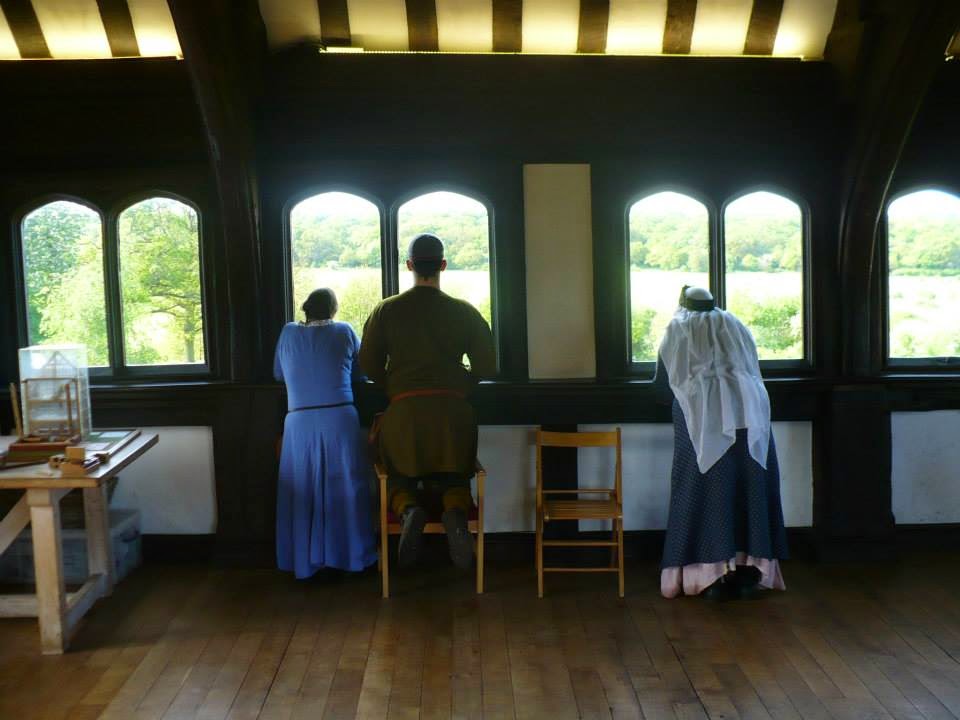
Dressing up helps, too!

I'm on the left. Queen Elizabeth's Hunting Lodge, Epping Forest, London.
Photo: Andrew Leavesley, used with permission.